The trial
Find a number
Search for one number whose keccak hash lands below the target. Your graphics card does the searching in this page.
Send it with the mint
The number travels with the mint call, so one transaction both proves the work and hands over two CHIP404. Free, gas only.
Watch the target climb
Every 150 CHIP404 taken, the target doubles. Whoever comes later pays in waiting time, or skips the search in the fast lane below.
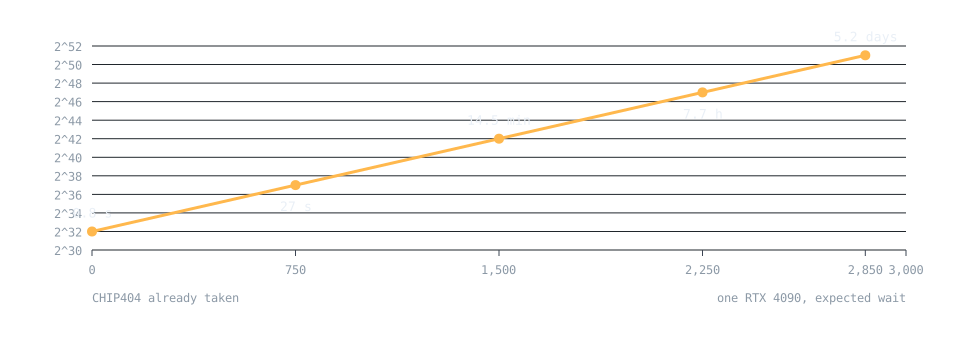
The wait shown is the expected time on one reference RTX 4090, about 5.06 billion hashes per second. The target is recomputed on every call from the CHIP404 already minted.
| CHIP404 already taken | Weight | Reference RTX 4090 | A browser doing the same work |
|---|---|---|---|
| 0 to 149 | 2^32 | 0.8 seconds | 3.9 hours |
| 750 to 899 | 2^37 | 27 seconds | 5.1 days |
| 1,500 to 1,649 | 2^42 | 14.5 minutes | 164.6 days |
| 2,250 to 2,399 | 2^47 | 7.7 hours | 14 years |
| 2,850 to 2,999 | 2^51 | 5.2 days | 231 years |
Those weights are measured, not guessed. The card column comes from about 5.06 billion hashes per second on a reference RTX 4090, and the last column from a browser running the search on an ordinary processor, measured at about 309,000 hashes per second. Press the measure button further down to get your own figure and see which rows you could ever reach. Sweeping the whole collection would take about 37,000 card hours, so the ladder is the wall, not a fee.
The wallet is filled in when you connect one above. Without it, any address you paste will be tested just the same.
The chain rebuilds keccak256 of the salt, your address and the number you send, then compares it with the target. Nothing here is stored or sent anywhere: the hashing happens in this page.